
Do the yellow pages still matter for local small business
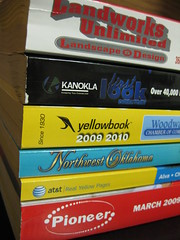 In an era when we all look up phone numbers online or even using our cell phone, why so many paper phone books? Alva, Oklahoma, population around 5000, is included in all six of these directories. One directory is new in the last year. And I don’t even have a copy of the City Directory, so that makes seven.
I want to let you in on a little secret: The directories don’t exist to benefit your business. They exist to make money for their publisher.
People’s Exhibit #1: AT&T has been on a campaign to eliminate the printed white pages in as many markets as they can, offering them on request only. As few as 1% of customers bother to request a copy, according to this news report. But of course, they are keeping the yellow pages. A St. Louis columnist kicked a flaming debate when he said AT&T makes millions from the yellow pages and then suggested that there is little benefit for advertisers any more.
I think directory publishers are coasting along on small businesses’ habit of advertising they way they always have. It’s so easy to let a relatively small expenditure roll over just one more year, especially when you think some business might have come from there. (If you think measuring social media Return On Investment is tough, try figuring out whether anyone actually used your yellow pages ad, even if you use tricks like “mention this ad” or include a special code.)
There’s a second habit they are relying on, too: competition. If your competitor is advertising, you feel like you have to, too. Glance through the attorneys section, or the physicians. How’s the ROI on those full page, full color ads? How many oilfield roustabouts really need a big display ad, and how many just feel pressured because all the other roustabouts are in there, too? (Yes, we really do have roustabouts, and some of them do advertise in the phone book.)
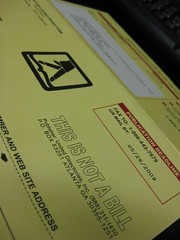 And that doesn’t count these scammy solicitations you’ll get in the mail, designed to look as much like yellow pages invoices as possible. You’ll get next to nothing for your money, if you bite. The directory may or may not even be printed! These are so common, you can read about them at the Federal Trade Commission. You have to catch and eliminate them, and be sure they don’t make it into your regular bill-paying process.
Did I mention all the scammy phone calls for inclusion in internet yellow page directories? Ignore them, too. Make sure that everyone who answers your business phone knows it. (I’m starting to sound like Maesz on a rant here, but I do object to slimy business practices! OK, deep breath, and onward to… )
Lessons:
Decide if yellow pages ads are right for your business at all. If your customers are not online, it might make sense. If your business does well in the yellow pages, I’d love to hear from you. Tell us why it’s right for your business.
Evaluate each phone book, before you advertise. See if your target customers are using it. Remember that for small towns, each regional directory covers a different territory that may or may not match your sales territory.
If you do advertise, track your results. And don’t fall into the “just one more year” trap. If it doesn’t generate enough business to pay for itself, kill the ad.
Focus more of your time on local search tools, like Google Local. We’ll talk all about that in a separate piece.
OK, I’ve calmed down. What do you have to say about the yellow pages? Do they still matter for your local small business?
New to SmallBizSurvival.com? Take the Guided Tour. Like what you see? Get our updates.
- About the Author
- Latest by this Author

Becky started Small Biz Survival in 2006 to share rural business and community building stories and ideas with other small town business people. She and her husband have a small cattle ranch and are lifelong entrepreneurs. Becky is an international speaker on small business and rural topics.




Couln’t agree more. Most small business that “advertise” in the Yellow Pages are just wasting their money. Unfortunately, the near-fradulent behavior of the “local” directories has now been extended to the internet. Make no mistake, Internet Yellow Pages and their surrogates are no more ethical that their print cousins. Companies like local.com are actively promoting national vendros to the detriment of small businesses. It is as much of a mess in cyberspace as it is in the old directory world. It’s not about relevance, it’s about advertising fees. If you are a local business, take care of how you spend your advertising dollar. Google local and Yahoo local and Microsoft local are the best ways to spend your energy. Better yet, they are mostly free!!!
Becky –
Thank you for providing an opportunity to comment. I work for Idearc Media, whose legacy is as the official publisher of the Verizon Yellow Pages. We are no longer your father’s yellow pages, having introduced two revolutionary programs positioning us as the advertising agency for local SMBs.
I could not agree with you more about making sure SMBs are careful with who they advertise with – – the days of salespeople trying to jam a round peg into a square hole – – no matter the advertiser a yellow pages ad is the only thing that can work – – are over. Our media consultants are developing marketing campaigns for our clients to appear in http://www.superpages.com (more unique visitors than ESPN.com), our SuperpagesDirect Direct Mail products and, when it is appropriate, our yellow pages.
Fact is, there is a need for a yellow pages. Unfortunately, for years the YP industry was focused on defending their product instead of differentiating it. Does a consumer really need four yellow pages from four different publishers that offer the same information? Probably not. By the way, for those wanting to opt out of the yellow pages, go to http://www.yellowpagesoptout.com. Enter your zip code and you’ll receive information on how to stop the delivery of all the yellow pages.
We believe one yellow pages – ours – that offers something special is all a consumer really needs.
We recently introduced the SuperGuarantee program available in all our products. When a consumer hires a painter, auto mechanic, contractor, plumber or other service provider that is part of our program, we will stand by the work. If there is a problem, we will step in and make it right. If we can’t, we will cut a check for up to $500 to the consumer. The program is free to both the consumer and eligible client.
For our SMBs, we’ve created the SuperTradeExchange (www.supertradeexchange.com) – a national barter program where our clients can provide goods and services to other clients within the exchange. A great way of doing business in a recession.
I hope you and your readers can see that there are benefits in working with the right company. Things can turn out super.
Again, thank you for the opportunity.
Andrew Shane
Andrew, thank you for a very informative comment. Good to hear you’re working toward providing new features. The guarantee seems to be more relevant in big cities, than in small towns where we already know the contractors and tradespeople, and sometimes several generations of their family!
So far, the comments from my local Facebook friends are running 1 for, 1 against whether they even use the yellow pages as customers.
I’m still looking for an actual small business owner, especially from a small town, to tell us why yellow pages still work for them.
And I hope everyone caught the important opt-out address that Andrew listed:
http://www.yellowpagesoptout.com
Oops… missed replying to Richard, there. Thanks for your input. We’ll be talking about the Google, Yahoo, etc., local options in another post, soon!
Hi Becky, this is great, nicely put. Yes I agree that YP companies are still resting on their laurels and selling on the belief that businesses ‘just have to be in it’ but in fact the story has changed. There are so many alternatives, that are cheaper or even free. I know you know of http://www.brownbook.net as just one example.
Thanks for a good read, Dave.
The only difference between newspaper and yellow pages is that the yellow page books continue to successfully sell. As to why that is? Well Becky, you captured it under the heading “It’s What We’ve Always Done”.
They’re both decaying media to be sure in an online, dynamic world. In a time when speed, flexibility and adaptability are critical to both service and success, it’s hard to fathom something more arcane than paying month after month for an unchangeable ad in a media that fewer and fewer people actually use.
Like the newspaper, the yellow page industry has, in my opinion, done a poor job of adapting to the interactive world. Yes, YellowBook and the rest offer online listings but they are often as horribly outdated as their printed brethren. And, for that matter, just aren’t very user friendly.
Small business needs to take the money they’re investing in one – or, God, more – yellow page books and invest that into being sure they’ve got an interactive, fresh online presence. As well as some mass broadcast media to, at the very least, bring people to the website. And endeavor to learn how to effectively use social media!
Great stuff Becky. Lead the charge!
Dave, Steve, thanks for your input. I think one thing that has hit newspapers harder than directories is the frequency of decision making. I only have to decide about the directories once a year. But the newspaper wants me to advertise every week.
Good point, Becky. Though I also wonder why that good size bill that comes from the YP each month for an ad that may very well now be outdated wouldn’t serve as a reminder to “not do this again!”
Steve, I think the answer is that they aren’t all billed monthly. The few ads I’ve placed were small enough I paid in a lump sum annually. But yes, others are billed monthly.
Hi Becky – I think all a small business owner has to do is ask themselves when is the last time they opened a print yellow pages to look for something. Chances are they won’t remember, and chances are their target markets aren’t doing it either. Polling customers is a way to determine effectiveness.
Secondly, your caveats on deceptive marketing practices are thorough. I’d add the “automatic renewal” clause in the contract. In years gone by, Dex Media – as an example – would make an effort to contact advertisers when a contract expired for renewal and modifications. They’d use it as an opportunity to upsell of course, but at least it resembled customer service. Now, contracts automatically renew. This could get you into a perpetual relationship with the company, or at least a couple of extra months of billing, if you’re paying attention to other stuff . . . as most business-owners are.
Betsy, thanks for adding that point. One more thing we need to watch out for.
This is slightly off topic.
BUT I see a real opportunity here for some enterprising entrepreneur to walk around the business district of their own small town convincing the older, less internet savvy, small storefront business owners to enlist the entrepreneur (for a small fee, of course) to set-up social media for the store. OR (for a slightly larger fee) to teach the business owner/operator how to set-up social media AND MAINTAIN/UPDATE their sites.
Alternatively, contact your nearest vo-tech and offer to teach a class for the mature, less internet savvy storefront owner/operator. Then walk around the business district and get the business people to sign-up for the class.
2d alternative, contact your local Chamber of Commerce and offer the same services.
Become the replacement for the yellow pages!
It’s a great idea, Maesz. And that is a whole ‘nother topic we need to talk about!
Last year I was managing a local music store. We always had a yellow pages ad and got some (not tracked) business through it. When we had a change of ownership, we decided not to renew our yellow pages ad. For the next 6 months, we continued to get calls about services that were listed in the Yellow Pages that we no longer offered. The Yellow Pages were definitely driving traffic in our direction, but since it wasn’t measurable, it was hard to quantify.
A local photographer who I did some web work for has similar stories. Because of the personal nature of his services, he asks EVERY customer how they heard about him. Referral and YP are the top 2.
HOWEVER… having dealt with the Yellow Pages ad people on and off for a few years, the number one selling point and justification for their cost is distribution numbers. This book goes out to 10,000 homes in this zone on the map. But with our current economy, how many homes and store fronts are empty? I wish I had taken a picture, but the shop next to mine (on both sides) had 2 different phone books hanging from door handle at one point last year. (neither of those stores had been open in the last 12 months and the one had been closed for years)
#1. How “green” is that?
#2 Those are your ad dollars going to those massive distribution numbers.
People are definitely still using the yellow pages. It isn’t a total waste. But you need to look at your niche and see whether its worth it. However the publishers need to take a look at real distribution numbers. Ask me whether I want a phone book (I don’t) and then reflect those new numbers to the SMB’s who are advertising. A targeted list of customers who actually use those books is way better than over inflated numbers anyways.
First of all, the whole tone of this blog is assuming that Yellow Pages thinks it is the only medium businesses need. That is false. Yellow Pages has always been touting the value of a Marketing Mix and spoke on the ability of Yellow Pages as a medium, to extend the reach of other advertising.
Second,the claim that Yellow Pages is out to make money. Obviously, none of you have owned businesses. Of course they are out to make money! That is why people are in business! Lets not be ridiculous.
Third, a separate White Page Directoery (they are only in very large cities) is not feasible any more but it has nothing to do with Yellow Pages any more then “War and Peace”.
Fourth, business people are not stupid! They don’t continue to invest in the Yellow Pages every year out of habit but because it makes them a profit. The amount of calls are not like they were in the 80’s for example but in many cases they still have their place.
Fifth, You think that advertisers just advertise in the Yellow Pages because their competition does? In part, you are right. It is called protecting your market share!
Sixth, the telephone companies that put out the genuine telephone book, don’t have any thing to do with phony invoices. The people that do that are crooks. What does that have to do with the print directories?
Seventh, in reference to the Internet Yellow Pages, be careful. The only one worth it is YELLOWPAGES.COM It has a page ranking from ComScore that is 28!!! Out of billions of web sites on the net, they are 28th!!! Should your business be listed? That is up to you but let’s all be careful that we don’t let our blogs overload our…. well you know.
In summation, is being on Google important? You are damn right it is! As information, that is why the major Yellow Page publishers are all insisting that it be part of the advertisers package for success. I have stated only facts, not opinions. Thank you for the opportunity to post.
I advertised my 1st in the yellow pages and I’m from a big city. I got exactly one client for my $1,500. I’ll never do it again- 95% of my business comes from the web ($59/year), 3% from referrals and the rest from well-placed advertising in publications that I like to support.
I felt the Yellow Pages was not of benefit, but did advertise because our competition was in there. Thanks for the insight. I’ll cancel the silly thing!
Chris, thank you for sharing exactly what I was looking for: actual experience from real small businesses.
James, well, all the best to you.
Anonymous, thanks for sharing your experience. I especially appreciate those actual figures.
Cynthia/Silver Barn, exactly. If it isn’t performing for you, don’t keep it.
Becky,
I am a small business owner in a medium size market. I have advertised in the yellow pages for nearly 15 years, in addition to newspapers, coupons etc.
I must agree with James Niarchos, in that I consider YP to be part of the overall advertising mix and extend the reach of all my advertising.
As a result of the negative print publicity, I recently started to carefully track all my advertising. I am utlizing unique call tracking numbers in each medium therefore I know exactly were the customer obtained my number. I have been doing this for the past 8 months. As I expected I still receive a higher ROI from the yellow pages then any other medium.
Thanks for sharing your experience. You must be exceptionally diligent about your record keeping.
Becky – I own a small business (30 employee HVAC company) though not in a small town (Huntsville, AL). While I do think you’re exactly right that yellow books — especially the scammy marginal ones — are of rapidly decreasing value, you really hit the nail on the head about measuring what you get for what you pay. We had decided to cancel a yellow book ad, but changed our minds and *renewed* it based on what we found when we actually looked at our call numbers: http://businessisinthedetails.com/marketing-and-selling/you-just-have-to-measure/
Keith, you have a great story, with numbers to back it up. Thank you!
As another small business owner with multiple locations in Polk County, FL, a couple of somewhat late additions to this discussion
1) whoever said business owners continue to advertise without evaluating results is correct – many do
2) on the other hand, I have indeed been a multiple-year advertising in Verizon Idearc yellow pages, and do not have access to any real measurement tools.
What is really throwing me a curve is that probably 15-25% of my customers (true, that is another guess) are over 60 and I still get lots of comments about “finding you in the yellow pages”
SO how would YOU invest your limited marketing dollars for 2010? YP or NOT??
If you are still getting comments from customers that they found you in the yellow pages, it’s still a valid tool for you.
A local photographer told me his business performs well in the yellow pages, but only in certain markets. In south central Kansas editions, he’s up against too many competitors. In southwest Kansas, he may be the only photographer and the customers, especially Hispanics, still use the phone book. So it pays to pay attention!
It was very interesting reading the responses to date regarding the Yellow Pages. I got the impression that if a response was in favor of using the Yellow Pages, it needed to be clarified if the respondent had a big business or was located in a big city. I think that these types of clarifications are moot, at best. Bottom line is that the key to a successful ad campaign in Yellow Pages has to be the ad being placed. The message is the most importanat ingredient in obtaining any form of ROI.
One of the respondents in this artoicle said that they won’t ever use Yellow Pages again because they spent $1500 and got only one customer. Gee, is that $1500 a month or a year? Did the one custome pay for the $1500 investment? Is your profit on a customer $1500 or more? Was your headline the name of your business and not what you can do for the reader researching your type of business? Was the ad a listing, several listings, and in-column ad or a display ad? 8 out of 10 who use the directory read display ads, not in column ads or listings. The reader does not care what your business name is. They care about what your business can do for them in time of needing your product or service should they choose you).
Many business owners don’t take the time to talk to their yellow pages rep and tell them what it is that they want out of the ad. they don’t take the time to tell the consultant what it is that makes their business different from their competitors. That’s a shame. They should. It will make a big difference in results.
Also, the yellow pages is the only form of direct advertising…meaning when people are looking you up in the yellow pages, they have a buying decision in mind. All other advertising is creative (even the cover ads and specialty ads foubnd in the yellow pages…they are creative as well). Your core book ad is directive. make sure you tell the reader why they should call you. Track the ad. Don’t rely on the consumer to tell you where they got your name. Some will never tell you the phone book anyway.
One last thing. Any customer you get from any of your advertising, yellow pages or other, has the ability to mention your products and services to others. In other words, yellow pages does promote referral business as well.
Kevin, thanks for adding your thoughts about designing better ads.
The Idearc media salesperson forgot to tell you one small detail, they are bankrupt. They filed for bankruptcy around May of this year. Good luck trying to find your local rep, as once they have a contract they never call you back. I have found that the AT&T yellowpages still work very well for me. I had my calls tracked and found that my ROI was great. Frankly I’m happy if more and more of my competition drops out of the book and goes on the internet. That just means less competition for me. My slice of the pie just gets larger. What is so bad about that? Becky, I feel your perception is way off when it comes to advertising. Maybe all your friends don’t us the phone book anymore, but you and your little group are hardly the universe.
I appreciate you sharing what works in your business. It would be more helpful if you would also share what industry you are in, some idea of the size of town or market, or even some more specific results.
Hi Becky,
Stumbled across your post today — several months late. If you ever want any data on yellow pages or yellowpages.com (or yp.com as it’s being rebranded) fire me off an email. I was an AT&T/SBC/Pac Bell yellow page rep for 11 years and before that with one of the independents.
I took the early retirement buy out from AT&T with glee in 2008 because my customers were daily talking about how it didn’t work any more. Our big customers were talking about a 30% or more decrease in their call counts – I wonder how much the counts have further decreased in the last 2 years? Another 30-40%??
If your target market is low end or low speed internet, yellow pages still works. But what used to make the yellow pages so fabulous was the ability to reach the very best customers – people with money in their pocket who wanted to buy something today – 100% of those people have abandoned yellow pages for their blackberry, iphone or high speed connection to all the info they could ever need. A web site contains way more relevant info than even the best full page ad does.
Julie
Julie, thanks for adding your experiences to the discussion.
Hi Becky,
I’m currently a plumbing contractor in Washington state, had a plumbing business in rural California and Ct. I like to travel and try my luck and have the skills to do so. I have vast amount of small town plumbing biz experience.
While Google and a good website does my small town plumbing business well, it does limit expansion out of town. We did open a shop in the next county, but then Google limited exposure even further to our physical address!
The yellow pages were great for expansion. All you needed to do was put your money down and you got exposure. Now, with the limited use and rising costs of the yellow pages, expansion is proving difficult using the y.p.
For service businesses who used yellow pages to expand and contract service areas, this new market isn’t fun. at. all.
Yours,
Robert
Robert, while it’s no longer as simple as that, there are still plenty of ways to get your local message out, online and off. I suggest you connect with some local help. You have lots of options.
Hi Becky,
I’ve tried contacting a few folk, but I was unsatisfied with their service offerings…none of them had dealt with a service company before.
What kind of company would best help me?
Thanks,
Robert
Robert, you might talk with my friend Julie Gallagher. She does video SEO from Sacramento and the surrounding area.
Hi Becky,
Got it. Thanks
Robert
I own a local pizza/pasta restaurant. I really love my yellow page advertising. I have tracked it and it helps my business tremendously!!! It was only $600 for the whole year and I have a full page ad with my menu. I bought from the local directory publisher because the bigger book was so expensive. I think you have to decide wether you are the type of business that really really needs it. Doctor, florist, towing, etc. I think it is a total waste of money if you are a shoe store!!! Just use your brain before you buy.
Thanks for sharing your experience. I think you could benefit even more by tracking your results from that source, and making sure it continues to produce well for you.
As early as 2010, Yellow Pages print and Internet got over 16 billion references in the US. 2008/2009 was a bad period for every business and every ad media.
My businesses have been doing very well with our yellow pages ads and our call counts have risen in 2010 and 2011. And it is the only medium that I can afford that gives me so much local exposure. My customers are LOCAL. I need to advertise LOCALLY, cheaply.
Ocelotl, if it works for you (and you know because you’re measuring it), then use it!
Brian sent this comment via email:
“I liquidate estates for a living and I have a unique opportunity to see what phone books are in peoples houses when they pass away or move. 10 years ago I would do a count to see where to advertise, but in the last couple years I have noticed that we rarely find a phone book anymore. everyone knows that the gen X people gave up phone books long ago, but we were all holding on for the baby boomers. but with the average age of my customers being in their 70s and 80s and still not having a phone book, I think its pretty evident that the demand has fallen off even for the elderly
second thing about tracking numbers. I had a tracking number once for a feist directory and it went directly to my cell phone. feist proudly showed me that I was getting 100-200 calls per month, a number I could easily disprove, and most of the calls I did get were from other advertisers wanting me to advertise with them. the worst part of the tracking number is that after they took it back, that tracking number showed up in advertisements from other search engines because they copied the information from their directory and it took years for that number to go away
the thing that I hate worse about the yellow pages is that I would continue to advertise with them if they would adjust their prices to fit what they are worth, instead of charging more than what they charged 10 years ago. Every other directory and newspaper has cut their print prices to reflect demand and YP.com just gets higher and higher(I currently spend more on YP. than every other online, print, website and email service AND advertising service combined and this is the last year I will use YP.”
Thanks for the updated perspective, Brian. That insight from estate sales is fascinating.